(314) 254-9766 info@byrneandjones.com
Byrne & Jones Wins American Sports Builder Association Award

Byrne & Jones Wins American Sports Builder Association Award

AmericanSportsBuilderAward 1

Multi-field complex in O’Fallon, Missouri recognized as one of nation’s best.

The American Sports Builders Association (ASBA) is recognizing the work done by Byrne & Jones Sports on behalf of the Missouri Rush Soccer Club for something that players, fans and coaches already know – their new facility in O’Fallon, Missouri is one of the best multi-field complexes in the country.

ASBA recently informed Byrne & Jones that the Missouri Rush Soccer Complex was a finalist in the Multi-Field category of its annual awards program that will take place in Scottsdale, Arizona in early December.

“A lot of hard work went into this project in a very tight time frame,” said Michael Soots, President of Missouri Rush Soccer Club.

Soots, who in addition to being President of Missouri Rush also served as the Construction Manager, praised the work ethic of Byrne & Jones. “I would definitely say the staff of Byrne & Jones exhibited a lot of the same core values as we try and emulate in our approach,” said Soots. “Jason Simpson, who was Byrne & Jones Superintendent on the project, held the entire staff to a higher standard – and it shows in the end product,” added Soots.

The complex features four, full-size soccer fields, all using the Greenfields Slidemax XP blend turf system. Byrne & Jones also self-performed the installation of concrete perimeter curbs and sidewalk, perimeter fencing and an asphalt overlay on two existing parking lots. Musco Lighting was installed by All Purpose Erectors.

The four soccer fields certainly see a lot of action. Over the past three years, Missouri Rush Soccer has grown to be one of the three largest clubs in the metro St. Louis area, working toward its mission of providing a safe and enjoyable environment for everyone to grow as players and people.

“Two years ago when we awarded Byrne & Jones the project in a very tight competition, Matt Hicks, their Director of Project Management, brought a real comfort level that proved to be the deciding difference,” said Soots. “Over the course of the project they really brought it home when it came to making you feel like family. And their understanding of working with the multiple trades around them really helped bring this project to life,” added Soots.

Now, Byrne & Jones Sports Construction is being recognized for their work by the ASBA – and soccer players from around the region are experiencing first-hand the excellence of the entire facility.

To put it simply, it’s a Rush – and that’s what soccer’s all about

Microsurfacing Contractors, LLC paves the way for future growth.

Microsurfacing Contractors, LLC paves the way for future growth.

MicrosurfacingContractors

New General Manager, ISSA awards and planned expansion into additional markets all create new opportunities for more work

Mike Kappel, the new General Manager of Microsurfacing Contractors, LLC is ready for a whole new set of opportunities. Kappel, who previously worked at Byrne & Jones Construction, the parent company of Microsurfacing Contractors, understands the importance of delivering quality on every single contract, always looking to exceed expectations

“The consistency of our crews and the knowledge and skill they bring to every job shows in our quality of work,” said Kappel. That is evident in Microsurfacing Contractors, LLC being a three-time winner of the President Award, presented by the International Slurry Seal Association.

“You simply cannot win that award without the knowledge and skill of a great team, backed by a great crew – and we’ve won it three times,” added Kappel. Great work, great planning and continual attention-to-detail all help Microsurfacing Contractors stand out in a market where the bulk of the work comes from bidding on state/county/and local municipality projects. Kappel’s previous experience at Byrne & Jones will certainly help in that regard as he ran the estimating department and operations for their Asphalt division and most recently was General Manager of the Concrete division.

The whole concept of using micro-surfacing to extend the life of a roadway is still new to a lot of potential clients. “Once we help clients understand the cost-saving implications of micro-surfacing over an extended period of time, our selling job becomes easier,” said Kappel. “Our reputation for doing quality work is growing and as that grows, that creates even more opportunities.”

Many of those new opportunities will come as Microsurfacing Contractors extends its service area with the opening of a new office outside of Columbus, Ohio later this spring. “Currently, we’re working with clients in Missouri, Illinois, Iowa and Indiana,” said Kappel. “With our new office that will be fully staffed and have its own micro-surfacing equipment, we’ll be ready to serve the micro-surfacing needs of customers in Ohio, Kentucky, Michigan and eventually other states.”

“It all comes back to our superintendents, project managers and our crews,” said Kappel. “They take great pride in the work they do and that shows in the end result. As a means of pavement preservation, micro-surfacing does a better job in extending the life of asphalt pavement. And nobody does a better job of it, than Microsurfacing Contractors, LLC.””

The Benefits of Adding Fiber to your Concrete Mix

The Benefits of Adding Fiber to your Concrete Mix

Concrete Fiber

The Benefits of Adding Fiber to your Concrete Mix?

Your mother always told you to get enough fiber…she wasn’t wrong! Fiber is beneficial to your health, and believe it or not, it can prolong the life of your concrete. So, is concrete fiber the same as dietary fiber? Not even close!

Fiber-reinforced concrete is concrete that contains fibrous material which helps to maintain the structural integrity. Concrete fibers are manmade materials that are typically made from steel, glass, and organic polymers. When added to the concrete mix (usually at the plant), these fibers help to reduce the cracking that naturally occurs with concrete. Since concrete is a rigid material, it is susceptible to cracking. The goal of these fibers is to “hold” the concrete together and to “hold” the cracks together. Fibers are a part of the system to reduce or control cracking and extend the life of your concrete pavement.

Cracking of concrete can occur due to changes in temperatures. Cracks can also arise as a result of density changes from setting the concrete. Fibers will not keep cracks from forming. Instead, the fibers are designed to hold the concrete together and prevent it from falling apart. When concrete is going through the curing process, the water inside the concrete evaporates. The method of water evaporation can cause cracks in the concrete. Fibers such as polypropylene reduce cracking by protecting the concrete from stress. Steel fibers reduce cracking by intersecting cracks and stopping their growth.

Fibers assist with freeze-thaw stress concrete that is exposed. Water expands when it is frozen, and water inside concrete is susceptible to freezing. If the water freezes, it creates pressure in the pores of the concrete. Once the pressure exceeds the tensile strength of the concrete, the concrete can rupture. Prolonged freeze-thaw cycles can cause cracking, scaling, pitting, and crumbling. When fibers are added to the concrete mix, its freeze-thaw resistance will improve.

So, you can see, fibers are an important part of extending the life of your concrete, and they cost very little to add to the mix – usually less than $0.20 cents a square foot.

The pavement preservation pros recommend adding fiber to your concrete mix in order to extend the life of your pavement. With 45+ years of experience, Byrne & Jones Construction has the horsepower and expertise to help. Ready to prolong the life of your concrete? Give us a call at (314) 254-9766.

What Are The Types of Infill That Go Into an Artificial Turf Field?

What Are The Types of Infill That Go Into an Artificial Turf Field?

InfillBlog

What are the types of infill that go into an artificial turf field?

The infill is the equivalent to the earth of a natural grass playing surface. The goal is to have the infill feel and perform like the “earth” of a natural grass field. The infill will determine how firm or fast a field plays, how the ball bounces and rolls, and it impacts how safe the fields are. The amount of infill needed is determined by how tall the fibers are, whether or not there is a shock pad being used, and the sport being played.

Infills typically fall into 5 categories. Each of these infills vary greatly, in both performance and cost.

  • Coated Sands
  • Coated SBR Rubber
  • Thermo Plastic Elastomers (TPE)
  • Virgin EPDM Rubber
  • Organic Infill

Understanding the different types of infill

The infill system is one of the most important aspects of all synthetic turf fields. It is the basis for the safety of the turf system by providing the appropriate cushioning to absorb impact. The infill provides the foundation to a field’s performance level by offering traction for players to cut, plant and release just like they would on natural grass.

Coated Sands – are made from uniformly sized natural sand and typically coated with acrylic, polyefin or an elastic coating.   These systems are usually a full depth infill system – not mixed with other mediums.  This infill does not require an irrigation system.  Shock pads are HIGHLY recommended if you are using a coated sand infill system. Most manufacturers require a shock pad, when using this infill.  Coated sand is subject to similar quality issues as TPE and as EPDM.  All three may clump over time.  Coated sand can add approximately $150,000 to $200,000 per field (this would include the cost of the shock pad.)  Coated sands are typically much cooler to the touch then SBR basic rubber system.  The maintenance of coated sand is similar to SBR systems; with a top dressing recommended in year five (5). 

Coated SBR Rubber – is very similar to the traditional SBR rubber infill. The SBR rubber product is typically coated with a virgin EPDM rubber. This system does not require an irrigation system. A shock pad is not required. However, if you are trying to pass a HIC Test a shock absorbing pad would be needed. Coated SBR can add approximately $40,000 per field. These infill systems are easy to maintain. The field will need to be top dressed every 5 years- at a cost of approximately $15,000.

Thermo Plastic Elastomers – (TPE) is similar in size to SBR rubber, but it is harder and typically rounder.  Thermo Plastic Elastomers are usually mixed with standard synthetic turf sands – to make up the infill system.  TPE comes in many colors and many variations for the aesthetics of a synthetic turf application.  Since TPE is a plastic, there is a risk over time of the TPE “melting” together.  This system does not require an irrigation system but will most likely require a shock pad. Some TPE manufactures claim their product can result in a 10 percent drop in temperature when used as an infill for artificial turf.  Maintenance of this system is very similar to the SBR systems…a top dressing is recommended every 5 years.

Virgin EPDM Rubber – is rubber that has not been recycled. It is similar in size to SBR rubber. This is the most common infill system that is used in the artificial turf industry. Rubber is mixed with standard synthetic turf sands.  EPDM comes in many colors and many variations for the aesthetics of a synthetic turf application.  This system does not require an irrigation system A shock absorbing pad is recommended. Maintenance of this system is very similar to the SBR systems with a top dressing recommended after 5 years of play.

Organic Infill – Most organic infill options are made from cork, walnut shells, coconut fiber, wood and or other similar products. 

Organic infills help produce the feel of natural grass, under foot. They make the fields play and perform more like natural grass too.  Because organic infills don’t conduct heat like the other infill systems, they are great at reducing field temperatures. Some organic infill systems claim they can reduce field temperatures up to 50-degrees.  

Most organic infilled systems will require an irrigation system. Water is necessary to keep the infill “hydrated”. This also assists with the temperature reduction.  Since most of the systems need water, as part of the recipe, the fields can be subject to freezing in the winter months.   

Because organic infills are very light weight, “floating” may occur. This can happen whenever there are heavy amounts of rain, in a short period of time, the infill will “float” or migriate to the sidelines. Shock pads are required when using organic infilled systems.  

This type of infill system can add $120,000 to $400,000 to your project – depending on the infill, irrigation, and the shock pad selected.  

How to Maintain A Parking Lot: From New Construction To Routine Repairs

How to Maintain A Parking Lot: From New Construction To Routine Repairs

How to Maintain a Parking Lot: From First Inspection to Long-Term Plan

Your parking lot is the first thing a tenant, a customer, or a prospective buyer touches. It’s also, on most commercial properties, the single largest square-foot asset outside the building itself — and the one most likely to be managed reactively, one pothole complaint at a time.

Reactive management is the expensive way to own pavement. A lot that gets a documented maintenance plan and a modest annual budget will outlast an identical lot that gets emergency repairs by the better part of a decade. This guide walks through how to build that plan: what to inspect, how to decide between repair and replacement, how to structure the budget, and how to get the work done without closing your property. If you’d rather hand the whole thing to a commercial asphalt paving contractor, we’ll get to that at the end — but you’ll manage the relationship better if you understand the sequence first.

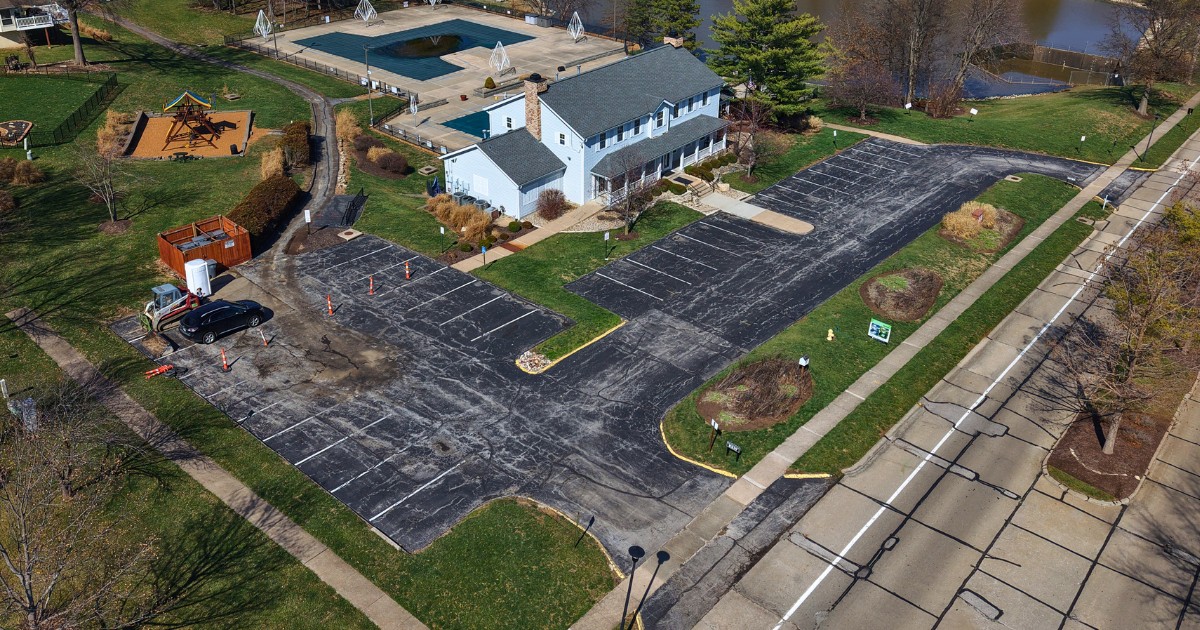
Flyover footage of the 2024 Hy-Vee work we did in Omaha Nebraska, an impressive project completed with our partner Rose Paving.

Why a plan beats reactive repairs

The economics of pavement are unforgiving in one specific way: deterioration isn’t linear. Asphalt loses condition slowly for the first several years and then falls off a cliff. Work done on the flat part of that curve is cheap. Work done after the drop is a capital project. The clearest illustration is crack sealing. According to the Pavement Preservation & Recycling Alliance, roughly 75% of unsealed cracks develop into potholes within three years — versus about 1% of sealed cracks over the same period. Sealing a crack is a minor line item. Replacing the base beneath a pothole that formed because water got in, froze, and expanded is not. Crack sealing alone typically buys three to five additional years of pavement life.

That ratio is the entire argument for a maintenance plan. You are not trying to keep the lot looking new. You are trying to stay on the cheap part of the curve for as long as possible.

ParkingLotRepairExperts 1

Step 1: Establish your baseline

You can’t budget for a lot you haven’t measured. Before anything else, document what you have.

Record the total square footage, the age of the surface and of any overlays, the original construction details if you can find them, and the current condition. Then walk it — ideally twice a year, and always after the winter thaw, which is when freeze-thaw damage from the previous season becomes visible.

On every walk, note and photograph:

  • Cracking — location, width, and whether it’s isolated linear cracking or interconnected “alligator” patterning
  • Potholes and areas where the surface has broken through
  • Standing water 24 hours after rain (the single best indicator of a drainage or grading problem)
  • Raveling — loose aggregate, a gritty surface, a lot that’s gone grey and dry
  • Faded or missing striping, ADA stalls, access aisles, and directional markings
  • Damaged or crumbling curbs, wheel stops, and sidewalk transitions
  • Depressions or humps, especially at drive aisles and loading areas

Photograph the same locations from the same angles each time. Two years of comparable photos turns a subjective argument with ownership about capital spend into a documented trend.

If you’re unsure what you’re looking at, our breakdown of the types of parking lot damage covers how to tell surface-level wear from base failure, and how potholes actually form explains why the small ones matter more than they look.

Step 2: Understand the four repair tiers

Almost every contractor recommendation falls into one of four categories. Knowing which one you are being quoted, and whether it matches what you documented, is most of the difference between a useful pavement budget and a wasted one.

Crack sealing

Cracks are routed out and filled to keep water from reaching the base. This gives the best return per dollar in pavement work and it is the item most often skipped. It suits isolated linear cracking where the rest of the surface is still sound.

Patching

Failed areas are cut out and replaced, either at the surface (skin patching) or through the full depth where the base has gone. Use it for potholes and small areas of alligator cracking. Only full-depth patching corrects a base problem, and a skin patch over failed base typically lasts a season.

Overlay and resurfacing

A new asphalt layer goes over the existing surface, usually after milling. This works when the base is still structurally sound but the surface is worn across most of the lot. As a rule of thumb, once a lot needs more than about 30% of its area patched, patching stops being economical and you should price an overlay instead.

Reconstruction and reclamation

The pavement structure is removed and rebuilt. You need this when the base has failed, when drainage has to be regraded, or when so many overlays have gone down that elevations no longer work at curbs and doorways. Full-depth reclamation recycles the existing material in place and is usually the faster and less expensive of the two rebuild options.

Repair, resurface or replace?

What you are seeing Likely tier
Isolated linear cracks, surface otherwise sound Crack sealing
A handful of potholes, less than about 30% of the lot affected Patching
Widespread surface wear, raveling or cracking, base still solid Overlay or resurfacing
Alligator cracking across large areas, pumping or sinking Full-depth patching or reconstruction
Water standing in the same places after every rain Grading and drainage correction, which resurfacing will not fix
Two or more overlays already down, curbs partially buried Reconstruction or full-depth reclamation

Drainage is the one that gets missed. Water sitting on a lot will shorten the life of whatever surface you put down, so a resurfacing bid that does not explain why the water is sitting there is only buying time.

Step 3: Protect the surface you have

Between structural repairs, three routine items do most of the preservation work.

Sealcoating

A protective coat applied over sound asphalt blocks UV, water, oil and de-icing chemicals. Most lots need it about every three years, or once the surface has faded from black toward grey. Because it improves appearance as well as protecting the pavement, it tends to be an easy line to get approved. Our guide to how sealcoating works goes through surface prep and cure requirements. One caution: sealcoat protects a sound surface and does nothing to repair a failing one, so applying it over cracking you have not addressed is money spent on appearance alone.

Sweeping and debris removal

Routine sweeping keeps sand, salt residue and organic debris out of the drainage system. Blocked drains lead to standing water, and standing water leads to base failure. This is the cheapest item on the list and the one most often cut from a budget.

Oil and chemical stains

Petroleum breaks down the binder that holds asphalt together. A fresh spill cleaned quickly does no lasting harm, but a stain left to sit will soften the surface and eventually need patching. Pay particular attention to the areas under dumpsters, around loading docks, and wherever fleet vehicles sit overnight.

Before and after images of a parking lot repaired by Byrne & Jones

Step 4: Striping, accessibility and liability

Striping is where pavement maintenance turns into a legal question rather than a facilities one.

Faded stall lines, worn arrows and illegible fire lanes create real exposure, as do accessible stalls and access aisles that have faded past the point of being identifiable or that no longer meet current dimension and slope requirements. Restriping costs very little compared with almost everything else here, so treat it as a recurring item rather than an occasional refresh.

Two practical notes. Restripe after sealcoating, never before. And where the layout allows it, shift stall lines slightly between restripings so traffic does not wear the same channels into the surface year after year.

The same reasoning extends past the asphalt. Curbs, wheel stops, sidewalk transitions and pedestrian routes sit in the same drainage system and the same premises liability picture, so include them in both the inspection and the budget.

Step 5: Build a budget ownership will approve

Pavement is easier to fund when you stop presenting it as one unpredictable expense and split it in two.

The annual operating line covers recurring, predictable work: inspections, sweeping, crack sealing, minor patching, restriping, and sealcoating spread across its cycle. Fund it every year whether or not anything looks urgent, because deferring it is what creates the large numbers later.

The capital reserve covers the eventual overlay or rebuild. Your condition assessments give you an approximate remaining life for the surface, so you can work backward from an estimated replacement cost and divide it across the years you have left. A lot with roughly eight years of surface life and a known replacement figure has a reserve number you can defend in a budget meeting.

Presented this way, the operating line reads as the thing pushing the capital number further out rather than as another request competing for the same money. For figures on what individual work items run, see our parking lot cost guide.

Step 6: Keep the property open while work happens

For most commercial sites this is the real constraint. A lot closed for a week is a business problem no matter how good the pavement looks afterward.

Nearly all parking lot work can be phased. A workable approach looks like this:

  • Divide the lot into zones and sequence them so a set percentage of stalls stays open throughout.
  • Map the required routes first: fire lanes, accessible stalls and the paths from them to the entrance, loading docks, drive-through lanes and emergency egress. These constrain the sequence more than stall count does.
  • Work off-peak. Retail sites usually phase overnight or midweek, office parks on weekends, schools and campuses over the summer, and healthcare or industrial sites overnight with tight reopening windows.
  • Confirm cure and reopening times before you publish a schedule. Sealcoat and striping both need cure time that varies with temperature and humidity.
  • Tell tenants early and give them a zone diagram with dates and alternate parking. Disruption people were warned about generates far fewer calls.
  • Build in weather contingency. Asphalt and sealcoat have temperature minimums, so assume you will lose days and publish the backup plan alongside the schedule.

It is reasonable to ask any contractor for a phasing plan before you sign anything.

Step 7: Choose a contractor before you need one

Set the relationship up while the lot is still in decent shape. You will get straighter assessments than you would calling around after a pothole has become a claim.

Look for a contractor running their own crews and equipment rather than layering subcontractors, with control over the asphalt mix and the ability to investigate base and subsurface conditions instead of quoting the surface alone. It also helps if they are willing to tell you a repair is not needed yet. Ask for references on properties similar to yours, since a company that does highway work well does not necessarily phase a shopping center well. Our guide to selecting an asphalt paving contractor goes further on comparing bids.

If you are past maintenance and comparing surfaces for a rebuild, start with asphalt vs. concrete for parking lots.

Parking lot maintenance checklist

Monthly

  • Sweep and clear debris, especially around drains and catch basins
  • Clean oil and chemical spills as they happen
  • Note any new potholes or surface breaks

Twice a year, spring and fall

  • Full walking inspection with photos from fixed reference points
  • Check for standing water 24 hours after rain
  • Inspect curbs, wheel stops and sidewalk transitions
  • Confirm accessible stalls, access aisles and fire lanes are legible

Every one to three years

  • Crack seal any new cracking
  • Patch failed areas before they spread
  • Restripe as legibility declines
  • Sealcoat on cycle, once the surface has faded and cracking has been addressed

Every 8 to 15 years, depending on traffic and condition

  • Overlay or resurface once patching exceeds roughly 30% of the lot
  • Reconstruct or reclaim when the base has failed or drainage must be regraded

Annually, on paper

  • Update the condition assessment
  • Fund the operating line
  • Adjust the capital reserve against remaining surface life

Timing these to your climate matters as well. If you are in a freeze-thaw region, our season by season parking lot maintenance calendar lays out which month each task belongs in.

Get an assessment in your market

Byrne & Jones has built and maintained commercial pavement for more than 50 years, with our own crews, our own equipment and our own material plants across the Midwest and Mid-South. For a condition assessment and a maintenance plan on your property, start with the office nearest you.

Or contact us and we will point you to the right team.