(314) 254-9766 info@byrneandjones.com
Asphalt vs. Post-Tension Concrete Courts

Asphalt vs. Post-Tension Concrete Courts

Choosing the Right Surface: Asphalt vs. Post-Tension Concrete

When you’re investing in a new athletic facility — whether it’s for a high school, a municipal park, or a private club — the most critical decision you’ll make isn’t the color of the paint or the height of the fence. It’s what lies underneath the surface.

At Byrne & Jones Construction, we’ve been building tennis and pickleball courts across the Midwest since 2010, completing over 1,400 projects for schools, universities, sports complexes, and parks. In that time, the single question we hear most often from facilities directors and athletic administrators is: “Should we go with asphalt or post-tension concrete?”

It’s the right question to ask — and it deserves a detailed, honest answer. This guide walks you through everything you need to know: how the two foundations are built, how they perform over time, what they cost, and how to decide which is right for your facility.

Already know which surface you want? Request a quote for tennis court construction or pickleball court construction and our team will get back to you.

The Four Factors That Should Drive Your Decision

Before we compare the two options head-to-head, it helps to understand the four variables that should shape your choice. Every facility is different, and the “right” answer depends on your specific situation.

1. Budget

How you plan to allocate funds between initial construction and long-term maintenance matters enormously. Asphalt is less expensive upfront, but that gap narrows — and eventually reverses — over time. If your capital budget is tight today but your maintenance budget has room to grow, asphalt may work. If you’d rather make a larger one-time investment and minimize future expenses, post-tension concrete is the better value.

2. Expected Lifespan and Replacement Cycle

How long do you intend to use these courts before a full rebuild? An asphalt court typically requires major rehabilitation within 15–20 years. A post-tension concrete court can deliver 30–40+ years of performance with minimal intervention. For facilities planning to be in place for decades, this difference is significant.

3. Maintenance Capacity

What is your facilities team’s bandwidth and budget for ongoing upkeep? Asphalt courts require more frequent attention — crack sealing, patching, and periodic resurfacing that can disrupt court availability and schedules. Post-tension concrete nearly eliminates structural maintenance, freeing up your team’s time and budget for other priorities.

4. Performance Goals

What playing experience do you want to deliver to your athletes? Both surfaces use the same acrylic top coat, so the visible finish is identical. The difference is in how the foundation behaves under players’ feet over time — and how consistently level and crack-free it stays through Midwest winters, freeze-thaw cycles, and years of heavy use.

Asphalt Courts: The Traditional Approach

Asphalt has been the standard tennis court foundation for decades, and for good reason: it’s a proven material, widely available, and less expensive to install than concrete. Understanding both its strengths and its limitations is essential to making an informed choice.

How It’s Built

An asphalt tennis court uses multiple compacted layers of asphalt paving to create the foundation — the same material used in road construction. These layers are graded carefully to achieve the proper slope for drainage, then topped with a cushioned acrylic surface system that provides the final playing color and texture.

The Pros of Asphalt

Lower upfront investment. Asphalt courts generally cost 20–30% less to install than post-tension concrete courts. For multi-court projects, that upfront savings can be substantial. Expect a general market range of approximately $60,000–$90,000 per court for a properly built asphalt installation, depending on scope, site conditions, and region.

Wider contractor availability. Because asphalt is a common construction material, there are more contractors with the general capability to pave it. However, tennis court construction requires specialized grading expertise — not all asphalt contractors are qualified to build courts. Always look for builders with ASBA certification or recognition for sports court work.

Familiar playing surface. When new, asphalt provides a classic playing feel that athletes are accustomed to. The acrylic surface applied on top is the same product used on post-tension courts, so color and texture are essentially identical at installation.

The Challenges of Asphalt

Cracking is a matter of when, not if. Asphalt is a flexible pavement — it moves with the ground beneath it. In the Midwest, where freeze-thaw cycles create significant ground movement, this flexibility becomes a liability. Facilities should expect to address minor cracking and settling within the first 5–7 years, requiring crack sealing and potentially patching to maintain a quality playing surface.

Ongoing maintenance disrupts schedules. Every few years, courts will need crack filling, leveling, and recoating. This isn’t just a cost — it takes courts out of service, often at inconvenient times. For schools or facilities with year-round athletic programming, repeated maintenance outages add up.

Lifespan is limited. An asphalt court foundation typically delivers 15–20 years before major rehabilitation is needed. At that point, you’re looking at either a significant structural overlay or a full tear-out and rebuild.

Higher long-term cost. When you account for crack repair, resurfacing cycles, and eventual major rehabilitation, asphalt can cost approximately $60,000 more per court over a 30-year period than post-tension concrete — despite its lower initial price tag. More on this in the cost analysis section below.

Lindbergh High School Recently Finished Tennis Courts
Naperville Tennis Courts

Post-Tension Concrete Courts: The Premium Option

Post-tension (PT) concrete has become the preferred foundation for competitive and long-term athletic facilities — and the reason comes down to engineering. This is not your standard concrete slab.

How It’s Built

Post-tension concrete uses a specialized engineering technique where high-strength steel cables are threaded through conduits within the concrete slab and tensioned — pulled tight — after the concrete has cured. This process puts the slab under constant internal compression. That compression is what makes it crack-resistant: the slab actively resists the ground movement, frost heave, and thermal expansion that cause traditional foundations to fail.

The Pros of Post-Tension Concrete

Crack resistance in any conditions. The tensioned cable system works against the forces that cause cracking. The result is a foundation that holds up through Midwest winters, poor soil conditions, and decades of use without the structural cracks that plague asphalt courts.

Lower long-term cost. While post-tension courts cost more upfront — typically in the range of $90,000–$120,000 per court — they require dramatically less maintenance over their lifetime. When you run the numbers across a 30-year window, PT concrete comes out approximately $60,000 per court less expensive than asphalt. That’s the crossover most facilities directors don’t see until it’s too late to change their decision.

Superior longevity. A properly installed post-tension concrete court can easily last 30–40+ years with minimal structural intervention. That’s a generational investment — the same courts your athletes use today could still be in excellent condition when the next generation of students arrives.

Minimal maintenance. You’ll resurface the acrylic top coat every 8–10 years to refresh color and texture, but the foundation itself requires virtually no structural maintenance. No crack filling. No patching. No worrying about freeze-thaw damage.

Perfect leveling and drainage. PT concrete allows for incredibly precise slope control during construction, ensuring better drainage and no standing water — a common problem on aging asphalt courts.

Preferred for competitive play. At the collegiate and competitive club level, post-tension concrete is the standard. If your facility hosts sanctioned tournaments or aspires to, it’s the appropriate surface.

The Challenges of Post-Tension Concrete

Higher upfront investment. The specialized materials and labor required for PT concrete command a premium at installation. For organizations with tight capital budgets, this can be a real constraint — which is why the phased-construction approach (building courts in stages across budget years) is a strategy worth considering.

Requires specialized expertise. Post-tension concrete must be installed by a contractor with the specific training and certification to work with tensioning systems. This is not a job for a general concrete contractor. At Byrne & Jones, we have certified PT concrete specialists on staff — but when evaluating any bidder, always verify this credential.

Longer cure time. Concrete requires a 28-day cure period before the acrylic surface can be applied. This extends the total project timeline compared to asphalt, which can be surfaced much sooner after paving.

Simpson College Post-Tension Concrete Courts

The Third Option: Crack Fill and Recolor (The Band-Aid)

Sometimes facilities come to us with courts that are showing their age — widespread cracking, fading color, and an uneven surface — but the capital budget for a full reconstruction isn’t available yet. In those situations, a crack fill and recolor can buy time.

Here’s what you need to know: this is a cosmetic fix, not a structural one. Crack filling and recoating will improve the court’s appearance and playability in the short term, but it does not address the underlying foundation issues. You’re not resetting the clock — you’re adding 1–2 years to the existing lifespan, at best.

That said, it can be a reasonable bridge strategy if a capital project is already approved for a future budget year and you need to keep courts usable in the meantime. General cost ranges for crack fill and recolor run approximately $12,000–$18,000 per court depending on the extent of damage and number of courts in the project.

If you’re considering this option, we’d encourage an honest conversation about whether you’re delaying the inevitable — and whether the money spent on a band-aid would be better rolled into the down payment on a long-term solution.

Head-to-Head Comparison

Feature Asphalt Courts Post-Tension Concrete
Typical Cost Per Court $60,000–$90,000 $90,000–$120,000
Expected Foundation Lifespan 15–20 years 30–40+ years
Cracking Risk High — typically appears within 5–7 years Very low — cable system actively resists cracking
Ongoing Maintenance Crack sealing, patching, resurfacing every 7–10 years Acrylic resurfacing every 8–10 years only
30-Year Total Cost Higher — approx. $60K more per court Lower — despite higher upfront investment
Weather Resistance Vulnerable to freeze-thaw cycles Excellent in all climates
Structural Integrity Subject to shifting and cracking over time Highly stable — compression-engineered
Playing Surface Feel Slightly softer — flexible base Firm, consistent — preferred for competitive play
Contractor Availability More contractors available (verify court-specific certs) Requires specialized PT-certified installer
Best For Tight capital budgets with stable soil conditions Long-term investment, competitive play, minimal maintenance

Why “Cheaper” Isn’t Always Better: The Long-Term Cost Analysis

The most common mistake we see facilities make is treating court construction as a pure upfront cost decision. When you look at only the initial price tag, asphalt wins. But when you look at total cost of ownership over 20–30 years, the picture reverses.

Here’s why: asphalt courts require structural maintenance on a recurring basis. Crack filling every few years. A structural overlay or major resurfacing around year 10–12. Another round of repairs in years 14–16. And by years 18–20, you’re often looking at a complete tearout and rebuild — meaning you’re essentially buying the court a second time.

Post-tension concrete, on the other hand, requires only periodic acrylic resurfacing — a routine, relatively low-cost operation that refreshes the playing surface without touching the foundation.

The math converges around year 18–20. That’s when the cumulative cost of maintaining asphalt courts catches up with the higher initial investment in post-tension concrete. After that point, asphalt keeps getting more expensive while post-tension stays relatively flat. Over a 30-year period, that difference adds up to roughly $60,000 per court in additional costs for asphalt — even after its lower starting price is factored in.

One more consideration: if your site has poor soil quality, high clay content, or a high water table, the calculation shifts even further toward post-tension concrete. Asphalt foundations are particularly vulnerable to expansive soils that shrink and swell with moisture changes. Post-tension concrete’s compression engineering makes it substantially more resistant to those conditions. When soil conditions are challenging, we almost always recommend post-tension — asphalt simply cannot bridge those gaps without failing prematurely.

The Byrne & Jones Verdict

After building over 1,400 athletic facilities across the Midwest, our honest recommendation is straightforward:

Choose asphalt if: You have a strict capital budget constraint today, your soil conditions are exceptionally stable, and you have the facilities bandwidth and budget to manage recurring maintenance over the court’s life.

Choose post-tension concrete if: You want a once-and-done solution that delivers the best long-term value, the lowest maintenance burden, and the highest quality playing experience for your athletes — for 30 to 40+ years.

For most school districts, universities, and parks departments we work with, the long-term math and the desire to minimize ongoing disruption point clearly toward post-tension concrete. But we understand that every facility operates within real-world budget constraints, and we’ll always give you an honest assessment of both options — including scenarios where a phased approach (building courts in stages across multiple fiscal years) can help you get to a PT concrete solution without exceeding a single year’s capital budget.

Ready to Get Started?

If you’re planning a new court construction project or evaluating options for aging courts, we’d love to talk. Our team includes certified track and field builders and in-house design specialists who can assess your site conditions, walk you through the numbers, and build a proposal that fits your goals and budget.

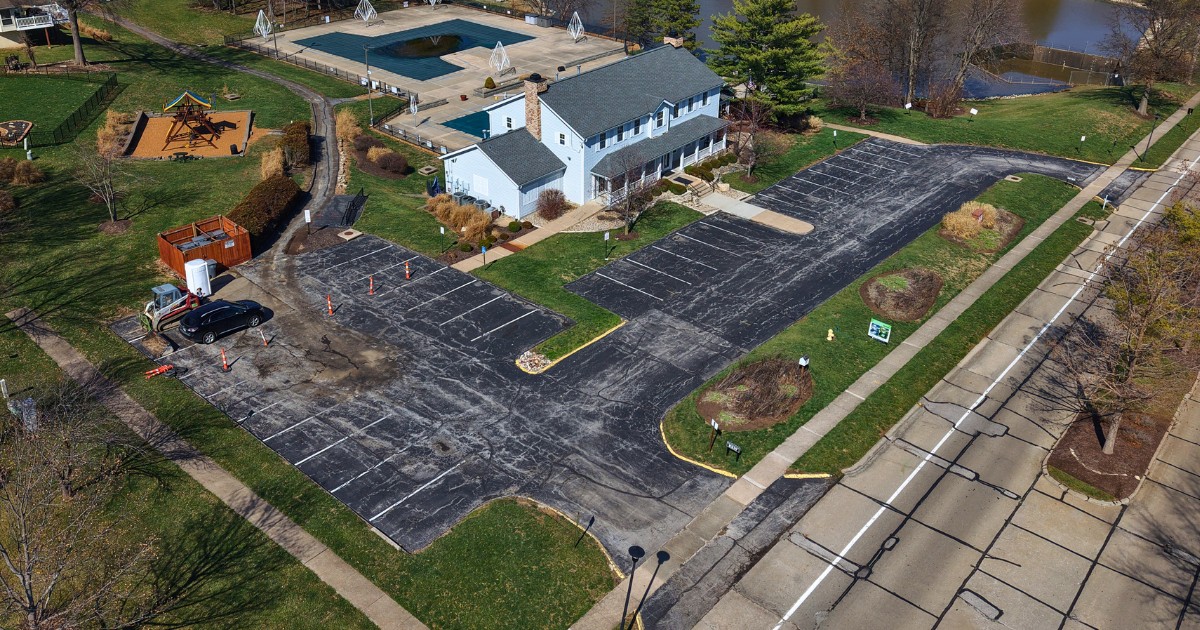
Cost of Columbus Parking Lots

Cost of Columbus Parking Lots

How Much Does Commercial Parking Lot Paving Cost in Columbus, Ohio? (2026 Guide)

If you manage commercial property in Central Ohio, you’ve probably gotten at least one paving bid that made you do a double take — either because it seemed too high, or suspiciously too low. Understanding what drives commercial parking lot paving costs in the Columbus market makes you a smarter buyer and helps you evaluate bids before committing to a contractor.

This guide breaks down realistic 2026 pricing for Columbus-area commercial paving, explains what drives cost variation, and tells you what to watch for when comparing bids.

Columbus Market Pricing: What to Expect in 2026

Commercial asphalt paving prices in Central Ohio have stabilized somewhat after the materials volatility of 2022–2024, but are still meaningfully higher than pre-pandemic benchmarks. For planning purposes, here are realistic installed price ranges for common commercial paving scopes in the Columbus metro:

  • New parking lot construction (full depth, including subgrade prep and base): $4.50–$7.50 per square foot
  • Asphalt overlay on structurally sound existing lot: $1.75–$3.25 per square foot
  • Full-depth reclamation and repave: $3.50–$6.00 per square foot
  • Crack sealing: $0.35–$0.75 per linear foot
  • Sealcoating: $0.12–$0.22 per square foot
  • Restriping: $0.08–$0.18 per lineal foot

These ranges are wide by design — the variables driving where your specific project lands within them are significant. A 50,000 sq ft lot in a Columbus suburb like Hilliard or Westerville will price differently than a tight urban lot in the Short North or a high-truck-traffic industrial access drive on the east side near Rickenbacker.

What Drives Cost Variation in Columbus

Subgrade Conditions

Central Ohio sits on glacial deposits — a mix of clay-heavy soils and glacial till that compresses and expands significantly with moisture and temperature changes. Columbus’s freeze-thaw cycle (typically 40–60 freeze-thaw cycles per year in Franklin County) is more aggressive than many Midwest markets, meaning subgrade preparation is not optional. Soft subgrade areas may require undercutting and replacement with granular fill, lime stabilization, or geotextile reinforcement — all of which add cost but are legitimate investments that determine how long your pavement lasts.

If a bid omits or vaguely describes subgrade preparation, that is not a bargain — it is a cost that will reappear as premature pavement failure within three to five years.

Lot Size and Configuration

Larger lots benefit from economies of scale — mobilization, equipment setup, and crew costs are spread over more square footage. A 5,000 sq ft lot will price significantly higher per square foot than a 50,000 sq ft lot. Tight configurations with many islands, curb returns, and ADA ramps require more hand work and increase unit cost. Lots with complex drainage patterns or significant grade changes also carry premium pricing.

Traffic Loading

A parking lot designed for passenger vehicles only requires a lighter pavement section than one that handles regular delivery trucks, waste haulers, or heavy equipment. Getting the pavement section right for your actual traffic mix — not just what looks adequate — is the difference between a 20-year lot and a 10-year lot. A qualified contractor will ask about traffic loading before proposing a pavement section.

Accessibility Requirements

ADA-compliant accessible space reconstruction, curb ramp installation, and accessible route resurfacing are line items that appear in nearly every commercial lot repaving project. Confirm that any bid includes ADA upgrades rather than carrying them as an allowance or exclusion — they are not optional, and the cost of an ADA enforcement action ($75,000+ in DOJ penalties for a documented violation) dwarfs the cost of getting it right at paving time.

Asphalt Material Costs

Asphalt is a petroleum-derived product whose price fluctuates with crude oil markets. In Columbus, liquid asphalt binder typically represents 35–45% of the mix cost. The Central Ohio market is served by several asphalt plants, providing reasonable competition on material pricing, but seasonal demand spikes (spring and early summer) and tight paving seasons can create supply constraints that affect pricing.

Columbus-Specific Cost Factors

The Freeze-Thaw Premium

Property managers who have managed commercial lots in both Columbus and southern markets often note that pavement investment goes further in warmer climates. This is real: Central Ohio’s freeze-thaw cycle is a significant pavement stressor that requires appropriate pavement design and materials to manage. Contractors who propose thin sections or omit base course work to hit a low price are setting you up for early failure in a market where pavement stress is higher than average.

Winter Paving Season Constraints

Unlike year-round paving markets, Columbus has a practical asphalt season of roughly April through October, with November being weather-dependent. Scheduling flexibility affects pricing — projects contracted for peak summer slots often carry small premiums over spring or fall work when contractor schedules are more open. Planning your paving project in the prior fall or winter for spring execution gives you the best pricing and scheduling position.

How to Compare Bids Intelligently

Lowest price is not the same as best value in commercial paving. When comparing bids in the Columbus market, verify that all bids include:

  • Clearly specified compacted asphalt thickness (not nominal or pre-compaction)
  • Subgrade preparation scope and compaction standard
  • Aggregate base specification (ODOT 304 or 411 aggregate is standard in Ohio)
  • Asphalt mix type (ODOT surface mix specification or equivalent)
  • ADA compliance work — either included as a firm price or explicitly excluded with a reason
  • Tack coat between lifts
  • Warranty terms — duration and what is and isn’t covered

A bid that is 20% below competitors and omits subgrade prep, specifies thinner asphalt, or excludes ADA work is not 20% cheaper — it is a different, lesser scope that will cost more over the life of the pavement.

Columbus Asphalt Paving Contractor

Getting an Accurate Estimate

For projects above 10,000 square feet, a reputable Columbus contractor should be willing to walk the site before providing pricing. On-site evaluation allows the contractor to assess drainage patterns, identify soft subgrade areas that may require extra prep, evaluate existing pavement condition, and confirm ADA compliance gaps — all of which affect pricing accuracy. A bid produced solely from lot dimensions without a site visit is an estimate that may change significantly once work begins.

Byrne & Jones Construction provides detailed written estimates for commercial paving projects throughout Central Ohio. 

Are Artificial Turf Fields Safe?

Are Artificial Turf Fields Safe?

Two athletes on a safe turf field

Are Artificial Turf Fields Safe For Athletes?

UPDATED MARCH 2026 — This post has been updated to include the California OEHHA Synthetic Turf Final Report (2026), one of the most comprehensive government-sponsored studies on turf safety to date.

If you’re an athletic director, parks director, or facility manager responsible for decisions about synthetic turf, you’ve fielded questions about safety. Is crumb rubber dangerous? What about PFAS? Should we be worried about injuries?

These are legitimate questions that deserve honest, evidence-based answers. Here’s where things stand.

The Crumb Rubber Question

The most persistent safety concern around synthetic turf involves crumb rubber infill made from recycled tires. Tire rubber contains polycyclic aromatic hydrocarbons (PAHs), volatile organic compounds (VOCs), and trace metals. The question is whether exposure during athletic use — breathing air near the surface, skin contact, incidental ingestion — presents meaningful health risks.

A multi-year EPA study concluded that chemicals in crumb rubber fields were present at levels below thresholds of concern for typical athletic use. The American Cancer Society reviewed the available literature and reached the same conclusion: the evidence does not support elevated cancer risk from playing on synthetic turf.

Webb City High School

The California OEHHA Study: The Most Rigorous Government Research Yet

In 2026, California’s Office of Environmental Health Hazard Assessment (OEHHA) released the most thorough government-sponsored crumb rubber study ever conducted. California sets some of the country’s most protective environmental health standards — that context matters when you read the findings.

OEHHA and Lawrence Berkeley National Laboratory collected samples from 35 randomly selected synthetic turf fields across California, spanning a range of field ages and climate conditions. They measured chemicals in the air during actual athletic play, analyzed crumb rubber samples, and assessed exposure across multiple routes: inhalation, skin contact, and ingestion. The study modeled exposure for soccer players — the group with the highest contact with the field surface — as well as coaches, referees, and spectators.

Turf Field Safe - Study Graphic

What the OEHHA Study Found

Overall conclusion: No significant health risks to players, coaches, referees, or spectators were identified from exposure to crumb rubber infill.

Athletes and coaches: Chemical exposures measured during play were below levels of concern across all exposure routes.

Spectators: No meaningful health risk identified.

Source: OEHHA Synthetic Turf Study, California Office of Environmental Health Hazard Assessment (2026).

Why This Study Carries Extra Weight

Most safety studies get dismissed as industry-funded or criticized for limited scope. The OEHHA study is neither. It was conducted by a state regulatory agency, independently funded, designed specifically to answer community health questions, and peer reviewed by a Scientific Advisory Panel. The fact that it came from California — which sets some of the nation’s most protective chemical exposure standards — gives it credibility that studies from less rigorous jurisdictions don’t have.

The study doesn’t end the conversation. OEHHA noted that research on synthetic turf continues and that the precautionary principle remains reasonable for families with very young children on sidelines. The industry’s ongoing shift toward alternative infills — TPE, organic infills, sand — reflects responsible progress. But for the core question — is it safe for athletes to play on a properly constructed synthetic turf field — the weight of evidence, including this 2026 study, says yes.

The PFAS Issue

PFAS (per- and polyfluoroalkyl substances) are synthetic chemicals used in a range of products, including some turf backing materials and infill components. The regulatory environment around PFAS is evolving, and the health concerns are real.

The industry is responding. Many turf manufacturers have committed to PFAS-free product lines or are actively eliminating PFAS from their products. When evaluating turf systems, ask manufacturers specifically about their PFAS status and request documentation of any certifications. It is a question worth asking, and any reputable manufacturer should be able to answer it clearly.

This is an area where working with a turf-neutral contractor matters. Byrne & Jones works with a large number of nationally recognized turf manufacturers and will get you just the right surface for your program. Our job is to understand your facility’s needs, your community’s concerns, and your budget — and then help you identify the system that best meets all three. That includes asking the hard questions about PFAS on your behalf.

Safe Turf Installation Being Performed by Byrne & Jones Sports Crews

How to Have This Conversation With Your Community

Transparency works. Acknowledge that community members have legitimate questions, then walk through the actual research — including the 2026 OEHHA study, which is the most credible independent analysis available. Share the specific certifications and testing data for the system you’re considering.

Parents and community members who feel informed are far more likely to support a project than those who feel their concerns are being dismissed. The evidence supports synthetic turf as a safe choice for athletic use when the right system is selected and properly installed.

Talk to Someone Who Builds These Fields

The questions parents, school boards, and community members are asking about synthetic turf are ones we answer every day. If you want to talk through what the research means for your specific facility — or just need help making the case to your community — we’re glad to help. 

6 Things to Know Before Building a Pickleball Court

6 Things to Know Before Building a Pickleball Court

Building a Pickleball Court
Untitled design

6 Things to Know Before You Decide to Build a Pickleball Court

In a pickle about what to do to stay active but also looking to enjoy time with your friends & family? Then you should consider trying out pickleball! 

It has been reported that this trendy sport has increased in popularity over 85% in 2023. This is even after the sport saw major growth in 2020-2022. Now is the perfect time to learn more about the sport. In the guide below, we will walk you through everyting you need to know before building a pickleball court!

Whether you’re a homeowner looking to create a fun backyard activity or a business owner interested in offering pickleball to your customers, building a pickleball court can be a great investment. However, before you start construction, there are several important factors to consider to ensure that your court is safe, durable, and enjoyable to play on. In this blog, we’ll discuss six key things you need to know before building a pickleball court.

1. What is pickleball?

Pickleball is a combination of tennis, badminton, and ping-pong that can be played as doubles or singles. This sport can be played indoor or outdoor, and the only equipment needed is a court, net, paddles, and a ball.

It is typically played on a court that is similar in size to a doubles badminton court, with a net that is similar in height to a tennis net. The game is played with a lightweight paddle and a plastic ball with holes. The trending sport is often played as a recreational activity in parks, community centers, and other public spaces.

2. What are the dimensions of a standard pickleball court?

The court shall be a rectangle 20 feet wide (6.10 m) and 44 feet long (13.41 m) for both singles and doubles matches.

A total playing area 30 feet wide (9.14 m) and 60 feet long (18.28 m) is the minimum size that is recommended. A preferred 10-foot (3.05-m) surrounding margin measures 40 feet (12.19 m) by 64 feet (19.51 m).

Court measurements shall be made to the outside of the perimeter and non-volley zone lines. All lines should be 2 inches (5.08 cm) wide and the same color, clearly contrasting with the color of the playing surface.

Check out the graphic below to get a better idea of what the dimensions of a pickleball court look like!

Pickleball Court Dimensions 1024x585 1

3. What are the different types of Pickleball Court playing surfaces?

  • Asphalt
  • Concrete
  • Turf

Asphalt courts are faster to construct, lower initial cost, and need more frequent maintenance. Concrete courts are more durable, low maintenance, and crack resistant. The biggest drawback to asphalt courts is that they crack (so may concrete). The difference is the concrete cracks don’t grow as wind as asphalt cracks. Asphalt can crack as wide a 2 to 4 inches. Post-tension will not allow the crack to widen, by keeping it compressed. An alternative playing surface to hard court surfaces that has gained popularity is an artificial turf-type surface. This option provides a crack-free surface that plays similarly to a real court, making it an excellent choice for those seeking an alternative to traditional hard courts.

If you are interested in learning more about the different types of pickleball court playing surfaces, you can read more in this blog we wrote.

4. How do you prepare the site for the construction of a Pickleball Court?

Before starting the construction of a pickleball court, it’s important to prepare the site properly. Here are some key steps to follow to ensure a successful construction process:

Evaluate the site: The first step is to evaluate the site where you plan to build the court. Look for a flat area that is large enough to accommodate the court size you desire. Check for any obstacles such as trees, rocks, or roots that may need to be removed.

Clear the site: Once you have chosen the site, clear it of any debris or vegetation. Remove grass and other vegetation from the site, and level the ground if necessary. This will ensure a stable and even surface for the court.

Mark the court boundaries: Use stakes and string to mark the boundaries of the court. Make sure that the dimensions of the court are accurate and that the lines are straight and properly aligned.

Prepare the base: The base is the foundation of the court, and it needs to be firm and stable. To prepare the base, first remove any soft or loose soil. Then, add a layer of crushed stone or gravel and compact it with a plate compactor. Finally, add a layer of fine gravel or crushed stone and again compact it.

Install the fencing: Once the base is prepared, you can install the fencing around the court. The fencing should be at least 10 feet high, and it should be made of a durable material such as chain link.

Install the court surface: Finally, install the surface of the court. There are several options to choose from, including asphalt, concrete, or specialized pickleball court surfacing. Make sure to choose a surface that is durable, slip-resistant, and provides proper ball bounce.

By following these steps, you can prepare the site for the construction of a high-quality pickleball court. With proper preparation, your court will be a safe, durable, and enjoyable playing surface for years to come.

5. What are the rules of pickleball?

Serving: The server must stand behind the baseline and serve underhand, with the paddle below the waist. The serve must land in the opposite diagonal court and clear the non-volley zone, which is a seven-foot area near the net.

Scoring: Points are scored by the serving team when the receiving team fails to return the ball or hits it out of bounds. A game is played to 11 points, and the winning team must win by two points.

Non-volley zone: The non-volley zone, also known as the kitchen, is a seven-foot area on each side of the net. Players cannot enter the non-volley zone to hit a ball unless the ball bounces first or the player is outside the zone.

Faults: A fault is committed when a player fails to serve the ball over the net, hits the ball out of bounds, or steps into the non-volley zone and hits the ball. A fault results in a point for the other team.

These are the basic rules of pickleball, but there are also more specific rules regarding line calls, double hits, and other aspects of the game. It’s important to familiarize yourself with the rules before playing to ensure a fair and enjoyable game.

6. What are common pickleball phrases?

Volley: A volley in pickleball is the act of hitting the ball in the air before it is able to bounce.

Fault: A fault in pickleball is an action that stops play because of a rule violation. Various faults can include when a ball is hit out of bounds, a ball bounces twice before it is hit by a player, and when a ball is hit into the net.

Kitchen: A kitchen in pickleball is the non-volley zone of the court. It extends 7 feet from both sides of the net.

Rally: A rally in pickleball is when there is continuous play from the time that the ball is served until fault. 

Pickled: Getting “pickled” means losing a pickleball game 11-0.  

Plummer Family Park Pickleball Courts

Bonus: Why is pickleball called “pickleball” and why has it become so popular?

In 1965, Joel Pritchard, the inventor of pickleball, was vacationing at his summer home on the Bainbridge Island in Washington. Upon looking for a fun activity for their children, Pritchard, along with Bill Bell and Barney McCallum created the game of pickleball with some broken paddles and a whiffle ball. Pritchard’s wife, a fan of rowing, claimed that this sport reminded her of a “pickle boat in crew where oarsmen were chosen from the leftovers of other boats.” From there, the sport was named pickleball.

However, rumor has it that the game was named after Pickles, Pritchard’s dog that would chase after the ball during pickleball games.

Accelerated during the pandemic, pickleball has grown by 21.3% just in the past year according to the Sport and Fitness Industry Association (SFIA). A popular sport amongst older generations, this game is played on a smaller court compared to tennis, which allows for less movement. While this sport allows for less intensity than tennis, it is still a great way to exercise. Another appeal of this sport is the simplicity of the rules and ability to understand the game. Since one only needs a few pieces of equipment to play, this game opens itself to a window of people. People of all ages are able to find this sport enjoyable, and it serves as a great social activity. 

Convinced to build a pickleball court?  Give us a call at (314) 254-9766 or contact us here!