(314) 254-9766 info@byrneandjones.com
How Weather Can Affect Asphalt & Concrete Surfaces

How Weather Can Affect Asphalt & Concrete Surfaces

Surface Repair

Understanding Weather Impact on Asphalt and Concrete Surfaces

Weather plays a crucial role in the longevity and performance of asphalt and concrete surfaces. From scorching sunlight to freezing temperatures, various weather conditions can significantly impact these materials.

Understanding these effects is key to maintaining durable, safe, and aesthetically pleasing surfaces for your property.

UV Damage and Heat Stress on Pavement

Asphalt Deterioration in Hot Weather

Asphalt surfaces face significant challenges under intense sunlight and high temperatures. UV rays trigger oxidation in asphalt, leading to a gray, weathered appearance that signals the beginning of surface degradation. As temperatures soar, asphalt can soften considerably, becoming more susceptible to deformation under heavy loads like parked vehicles or high-traffic areas. This softening can lead to rutting and permanent indentations in the pavement.

Additionally, extreme heat causes thermal expansion in asphalt, potentially resulting in buckling or warping of the surface, especially in areas with poor base support or inadequate expansion joints.

Concrete Degradation Under High Temperatures

Concrete, while generally more heat-resistant than asphalt, is not immune to the effects of high temperatures. Excessive heat can accelerate the curing process of freshly laid concrete, potentially compromising its long-term strength and durability. This rapid curing can lead to a weaker overall structure as the concrete doesn’t have adequate time to develop its full strength potential.

Moreover, hot and dry conditions often result in surface crazing – a network of fine, shallow cracks that not only affect the appearance but can also serve as entry points for moisture and contaminants, leading to more severe damage over time.

St. Louis Concrete Repair

Freeze-Thaw Cycle Effects on Pavement Materials

Asphalt Damage in Cold Climates

Cold weather presents its own set of challenges for asphalt surfaces. As temperatures drop, asphalt contracts, creating internal stress that often leads to cracking. These cracks, however small initially, become significant problems during freeze-thaw cycles. Water seeps into these cracks and, upon freezing, expands, forcing the cracks to widen. This cyclical process of freezing and thawing can rapidly deteriorate asphalt surfaces, leading to more extensive cracking, potholes, and overall structural damage if left unaddressed.

Concrete vulnerabilities in freezing Conditions

Concrete faces similar challenges in cold climates, with some unique vulnerabilities. Freezing temperatures significantly slow down the curing process of freshly poured concrete, potentially weakening its final strength. This is particularly problematic for construction projects that extend into colder months. A more visible and destructive effect is frost heaving, where water beneath the concrete freezes and expands, causing sections of the pavement to lift and crack. This not only creates an uneven surface but can also compromise the structural integrity of the entire concrete slab.

Asphalt Pavement Preservation Graphic

Rainfall and Snow Impact on Road Surfaces

Asphalt Erosion from Precipitation

Rainfall and snow pose significant threats to asphalt surfaces. Heavy rainfall can erode the surface of asphalt, particularly in areas that are already damaged or weakened. This erosion strips away the protective top layer, exposing the underlying structure to further damage. Water infiltration is another major concern; rainwater seeps into cracks and crevices, weakening the subbase and potentially leading to the formation of potholes. In winter, the use of de-icing chemicals, while necessary for safety, can accelerate asphalt deterioration by breaking down the bonds in the asphalt mixture.

Concrete Damage from Water and Ice

Concrete surfaces are also vulnerable to water and ice damage. The freeze-thaw cycle, combined with the use of de-icing chemicals, can cause scaling – a process where the surface of the concrete flakes off, exposing the aggregate beneath. This not only affects the appearance but also the structural integrity of the concrete. Another common issue is efflorescence, where water moving through the concrete brings dissolved salts to the surface, leaving behind white, powdery deposits. While primarily an aesthetic issue, efflorescence can indicate ongoing water penetration problems that may lead to more serious structural concerns.

Wind and Debris: Hidden Threats to Pavement Longevity

Wind and debris pose subtle but persistent threats to both asphalt and concrete surfaces. Over time, wind-blown particles act like sandpaper, gradually abrading the surface of pavements. This abrasion can wear down the protective top layer, making the surface more susceptible to other forms of damage. Additionally, debris such as leaves and organic matter can accumulate on pavement surfaces, trapping moisture against them. This trapped moisture can accelerate deterioration, especially in areas with poor drainage or during extended periods of wet weather.

Humidity Effects on Pavement Materials

Moisture-Related Asphalt Issues

High humidity levels can have detrimental effects on asphalt surfaces. One of the most significant issues is stripping, where high humidity causes the bond between asphalt and aggregate to break down. This weakening of the internal structure can lead to raveling, where aggregate particles become dislodged from the surface, creating a rough and potentially hazardous road condition.

Concrete Challenges in Humid Conditions

Concrete is also affected by humidity levels. High humidity can significantly slow the setting process of freshly poured concrete, potentially affecting its final strength and surface quality. Conversely, rapid drying in low-humidity conditions can lead to shrinkage cracks, compromising both the appearance and structural integrity of the concrete surface.

Cracks in Asphalt Surface from Winter weather

Weather-Resistant Pavement Maintenance Strategies

Implementing proactive maintenance strategies is crucial for combating weather-related pavement damage. Regular inspections, especially after extreme weather events, can identify potential issues before they escalate into major problems. Prompt repairs of cracks and other damages are essential to prevent water infiltration and further deterioration. For asphalt surfaces, applying sealcoat every two to three years provides a protective barrier against UV rays and water damage. Ensuring proper drainage is vital for both asphalt and concrete surfaces to minimize standing water, which can lead to numerous problems. Additionally, considering weatherproof treatments or additives can enhance the resilience of pavement materials against various weather conditions.

Expert Solutions for Weather-Resilient Pavements

While basic maintenance can be handled in-house, professional services offer advanced solutions for weather-resilient pavements. Experts in the field have access to cutting-edge weather-resistant materials and techniques that can significantly extend the life of your pavement. Their expertise in local climate challenges allows for tailored solutions that address specific regional weather patterns. Professional intervention typically results in long-term solutions that are more cost-effective than frequent repairs or premature replacement.

Expert Solutions for Weather-Resilient Pavements

Weather is a relentless force acting on asphalt and concrete surfaces, but understanding its effects and implementing a weather-aware maintenance strategy can significantly extend the life of your pavement. By staying proactive and engaging professional expertise when needed, you can maintain safe, durable, and aesthetically pleasing surfaces that withstand the test of time and nature. Remember, in pavement maintenance, prevention is always more cost-effective than major repairs or replacement. Adopting a proactive approach to weather-related maintenance ensures your surfaces remain resilient against the diverse challenges posed by climate conditions.

Parking Lot Surface Options: Asphalt vs Concrete Comparison Guide

Parking Lot Surface Options: Asphalt vs Concrete Comparison Guide

Choosing the best parking lot surface for your next parking lot project blog graphic

Parking Lot Surface Options: Choosing Between Asphalt and Concrete Comparison Guide

When it comes to choosing the best surface for your parking lot, the two main options that business owners and property managers consider are asphalt and concrete. Both materials have their advantages, and the right choice depends on various factors specific to your project. This comprehensive guide will help you compare asphalt and concrete parking lot surfaces to make an informed decision.

Comparing the pros and cons of Asphalt and Concrete Parking Lot Surfaces

Cost Considerations

The cost of asphalt versus concrete is often a primary consideration when it comes to deciding which surface is best for a parking lot. Generally, asphalt parking lots are less expensive to install initially. However, it’s important to consider the long-term costs as well. While concrete may have a higher upfront cost, it often requires less frequent maintenance, which can lead to lower expenses over time. 

When comparing the cost of asphalt driveways versus concrete, the same principles apply. The initial investment for a concrete driveway is typically higher, but its longer lifespan may offset this cost over time.

Durability and Lifespan

Concrete parking lots generally have a longer lifespan compared to asphalt. A well-maintained concrete lot can last 30-40 years, while asphalt typically lasts 20-30 years. However, it is important to remember that for an asphalt surface to last that long, an asphalt maintenance plan should be put in place at the time of installation. An asphalt maintenance plan can help parking lot owners better understand the long-term costs associated with maintaining an asphalt surface. This difference in longevity should be factored into your decision, especially if you’re planning for the long term.

Maintenance Requirements

Asphalt requires more frequent maintenance, including sealcoating every 3-5 years to protect the surface. Concrete, while generally requiring less frequent maintenance, can be more expensive to repair when damage does occur. Consider your capacity for regular maintenance when choosing between these options.

Climate and Weather Considerations

Your local climate plays a significant role in determining the best surface for your parking lot. Asphalt tends to perform better in cold climates and areas with frequent freeze-thaw cycles. It’s also worth noting that parking a car on grass in winter can be problematic, making a paved surface essential in colder regions.

Concrete, on the other hand, performs well in hot climates as it doesn’t soften or become sticky in extreme heat. However, it can be more prone to cracking in very cold temperatures.

Traffic Load and Usage

Consider the type and volume of traffic your parking lot will experience. Concrete is generally better suited for heavy vehicles and high traffic areas. For multi-level parking design standards, concrete is often preferred due to its strength and durability.

Asphalt works well for standard passenger vehicles and moderate traffic. It’s often used in residential parking design due to its cost-effectiveness and ease of installation.

Installation Time and Process

Asphalt can typically be used within 24-48 hours after installation, making it a good choice when time is a critical factor. Concrete requires a longer curing time, usually at least a week before it can bear vehicle weight.

Aesthetics and Customization

Concrete offers more design options, including the ability to add color or stamp patterns into the surface. For those interested in interlocking bricks for parking or parking tiles for home use, concrete pavers can provide an attractive and durable option.

Asphalt provides a uniform, dark surface that many find attractive in its simplicity and is effective at hiding oil stains and tire marks.

Choosing between an asphalt or concrete surfacing for a parking lot

Alternative Parking Lot Surface Materials

While asphalt and concrete are the most common choices, there are other parking lot surface options to consider:

  1. Permeable pavers: These allow water to drain through the surface, reducing runoff and potentially helping with stormwater management.
  2. Gravel: A cost-effective option for low-traffic areas, though it requires regular maintenance. If you are considering gravel, check out this guide.
  3. Recycled materials: Some innovative solutions use recycled plastic or rubber to create durable parking surfaces.

Parking Lot Construction and Repair

Whether you’re building a new parking lot or repairing an existing one, proper construction techniques are crucial. This includes ensuring adequate drainage, proper subgrade preparation, and appropriate thickness of materials.

For those wondering about parking lot repair costs, it varies depending on the material and extent of damage. Asphalt repairs are typically less expensive than concrete, but may be needed more frequently.

Making the Right Choice for Your Parking Lot

When deciding between asphalt and concrete for your parking lot surface, consider your budget, climate, expected traffic, aesthetic preferences, and long-term plans. Remember, there’s no one-size-fits-all solution – the right choice depends on your unique circumstances and priorities.

Need expert advice on your parking lot project? Whether you’re looking at parking lot material options, considering the cost of asphalt vs concrete, or exploring the best material for a parking area, Byrne & Jones Construction can help. Contact us for a free consultation at (314) 254-9766. We specialize in both asphalt and concrete solutions to meet your unique parking lot needs.

Discover the many benefits of Full-Depth Reclamation

Discover the many benefits of Full-Depth Reclamation

FDRBenefits

Discover the Many Benefits of Full-Depth Reclamation

Full-depth reclamation (FDR) is revolutionizing asphalt rehabilitation. This innovative technique offers a cost-effective, environmentally friendly solution for extending the life of deteriorating roadways. Discover how Byrne & Jones Construction utilizes FDR to provide superior asphalt solutions to our clients.

What is full-depth reclamation?

Full-depth reclamation (FDR) is an advanced pavement rehabilitation technique that transforms deteriorated asphalt pavements into strong, durable base courses for new road surfaces. This innovative process involves pulverizing the full depth of the existing asphalt pavement along with a predetermined portion of the underlying base, subbase, or subgrade materials. The resulting mixture is then blended, reshaped, and compacted to create a homogeneous base layer.

Key aspects of FDR include:

  1. Depth of Treatment: FDR typically addresses 4 to 12 inches of the pavement structure, allowing for comprehensive rehabilitation of the roadway.
  2. In-Place Recycling: Unlike traditional methods that require removal and disposal of old materials, FDR recycles existing pavement materials on-site, significantly reducing waste and transportation costs.
  3. Material Enhancement: Depending on project requirements, additional aggregate, chemical stabilizers, or bituminous materials may be incorporated to improve the performance characteristics of the reclaimed layer.

What are the different types of full-depth reclamation?

  • Mechanical Stabilization: includes the addition of aggregate materials
  • Chemical Stabilization: includes the addition of lime, cement, or fly ash
  • Bituminous Stabilization: includes the addition of asphalt based emulsions or foamed asphalt

Intersted in the process of Full Depth Reclamation? Check out this video. 

Full-Depth Reclamation being performed in St. Louis, MO.

What are some of the advantages of Full Depth Reclamation?

Cost-Effective

This process has proven to be cost effective as it creates long lasting pavement, leading to less repairs down the road. The FDR process creates a higher load carrying capacity and also reduces moisture susceptibility. The result is a stronger, longer-lasting surface. Combine that with the cost-savings, and Full Depth Reclamation becomes an even more attractive alternative to completely removing and installing a new asphalt surface.

More owners are discovering they can save 30%-50% of total project costs when they let the experts at Byrne & Jones Construction perform the Full Depth Reclamation process on their worn-out asphalt parking lots.

Time-Efficient

Full-Depth Reclamation significantly reduces project timelines compared to traditional reconstruction methods. The in-place recycling process eliminates the need for extensive material removal and replacement, allowing projects to progress rapidly. With specialized equipment, FDR can treat large areas quickly, often completing several miles of roadway in just a few days. This efficiency minimizes traffic disruptions and reduces the overall impact on local communities and businesses. By streamlining the rehabilitation process, FDR enables faster project completion, allowing roads to reopen sooner and reducing labor costs. The time savings provided by FDR translate to both economic benefits for project owners and reduced inconvenience for road users.

Versatility

Full-Depth Reclamation adapts to a wide range of pavement rehabilitation needs. From highways and local roads to parking lots and airport runways, FDR offers a solution for various infrastructure types. This versatility allows project managers to apply a single, efficient technique across diverse projects, streamlining operations and reducing the need for multiple specialized approaches. FDR’s adaptability to different pavement conditions and traffic loads makes it an invaluable tool in any road maintenance arsenal.

Superior Structural Improvement

FDR addresses pavement issues at their core, providing comprehensive structural enhancement. By pulverizing and reconstituting the entire pavement section, including the base layers, FDR corrects deep-seated problems like rutting, cracking, and poor drainage. This thorough approach results in a stronger, more uniform pavement structure capable of withstanding heavy loads and environmental stresses. The improved structural integrity translates to longer-lasting roads, reduced maintenance needs, and enhanced safety for road users.

Highly Customizable Process

Every road rehabilitation project has unique challenges, and FDR offers the flexibility to meet them head-on. The process can be tailored to specific project requirements, allowing engineers to adjust variables such as treatment depth, stabilizer type, and mix design. This customization ensures optimal results for each application, whether it’s increasing load-bearing capacity for heavy traffic routes or enhancing durability in harsh climates. The ability to fine-tune the FDR process results in more efficient use of resources and better long-term performance of the rehabilitated pavement.

Environmentally Friendly  

Since this technique uses reclaimed material, it has less of an impact on the environment. Head of Byrne & Jones Construction Asphalt Division, Kevin Klette says, “Instead of having to dig up and remove the old asphalt surface before installing a new one, FDR pulverizes the old surface, compacts it, and then we mix an additive that creates a stronger base for the asphalt mix.” According to the National Asphalt Pavement Association, 2.4 million metric tons of CO2e were spared from the atmosphere in 2019 through the use of reclaimed asphalt pavement (RAP) in new mixtures. 

This technique allows for the conservation of energy and material. According to Klette, “Full Depth Reclamation offers more than just cost-savings. It helps conserve energy since there’s no need to haul away or import new materials. It saves natural resources and energy since it recycles existing material and it eliminates material disposal concerns, making it a much more environmentally-friendly route to take.”

Full Depth Reclamation requires a variety of specialized equipment that most asphalt paving contractors simply do not have. Byrne & Jones Construction not only has the equipment, but also has the know-how to perform the variety of steps involved throughout the process. If you are interested in seeing Byrne & Jones Construction’s work in person then call and ask about our jobs at Watlow Electric or Ladue Middle School. To schedule a live recycling demo, contact us at 314-254-9766.

How to Maintain A Parking Lot: From New Construction To Routine Repairs

How to Maintain A Parking Lot: From New Construction To Routine Repairs

How to Maintain a Parking Lot: From First Inspection to Long-Term Plan

Your parking lot is the first thing a tenant, a customer, or a prospective buyer touches. It’s also, on most commercial properties, the single largest square-foot asset outside the building itself — and the one most likely to be managed reactively, one pothole complaint at a time.

Reactive management is the expensive way to own pavement. A lot that gets a documented maintenance plan and a modest annual budget will outlast an identical lot that gets emergency repairs by the better part of a decade. This guide walks through how to build that plan: what to inspect, how to decide between repair and replacement, how to structure the budget, and how to get the work done without closing your property. If you’d rather hand the whole thing to a commercial asphalt paving contractor, we’ll get to that at the end — but you’ll manage the relationship better if you understand the sequence first.

Flyover footage of the 2024 Hy-Vee work we did in Omaha Nebraska, an impressive project completed with our partner Rose Paving.

Why a plan beats reactive repairs

The economics of pavement are unforgiving in one specific way: deterioration isn’t linear. Asphalt loses condition slowly for the first several years and then falls off a cliff. Work done on the flat part of that curve is cheap. Work done after the drop is a capital project. The clearest illustration is crack sealing. According to the Pavement Preservation & Recycling Alliance, roughly 75% of unsealed cracks develop into potholes within three years — versus about 1% of sealed cracks over the same period. Sealing a crack is a minor line item. Replacing the base beneath a pothole that formed because water got in, froze, and expanded is not. Crack sealing alone typically buys three to five additional years of pavement life.

That ratio is the entire argument for a maintenance plan. You are not trying to keep the lot looking new. You are trying to stay on the cheap part of the curve for as long as possible.

ParkingLotRepairExperts 1

Step 1: Establish your baseline

You can’t budget for a lot you haven’t measured. Before anything else, document what you have.

Record the total square footage, the age of the surface and of any overlays, the original construction details if you can find them, and the current condition. Then walk it — ideally twice a year, and always after the winter thaw, which is when freeze-thaw damage from the previous season becomes visible.

On every walk, note and photograph:

  • Cracking — location, width, and whether it’s isolated linear cracking or interconnected “alligator” patterning
  • Potholes and areas where the surface has broken through
  • Standing water 24 hours after rain (the single best indicator of a drainage or grading problem)
  • Raveling — loose aggregate, a gritty surface, a lot that’s gone grey and dry
  • Faded or missing striping, ADA stalls, access aisles, and directional markings
  • Damaged or crumbling curbs, wheel stops, and sidewalk transitions
  • Depressions or humps, especially at drive aisles and loading areas

Photograph the same locations from the same angles each time. Two years of comparable photos turns a subjective argument with ownership about capital spend into a documented trend.

If you’re unsure what you’re looking at, our breakdown of the types of parking lot damage covers how to tell surface-level wear from base failure, and how potholes actually form explains why the small ones matter more than they look.

Step 2: Understand the four repair tiers

Almost every contractor recommendation falls into one of four categories. Knowing which one you are being quoted, and whether it matches what you documented, is most of the difference between a useful pavement budget and a wasted one.

Crack sealing

Cracks are routed out and filled to keep water from reaching the base. This gives the best return per dollar in pavement work and it is the item most often skipped. It suits isolated linear cracking where the rest of the surface is still sound.

Patching

Failed areas are cut out and replaced, either at the surface (skin patching) or through the full depth where the base has gone. Use it for potholes and small areas of alligator cracking. Only full-depth patching corrects a base problem, and a skin patch over failed base typically lasts a season.

Overlay and resurfacing

A new asphalt layer goes over the existing surface, usually after milling. This works when the base is still structurally sound but the surface is worn across most of the lot. As a rule of thumb, once a lot needs more than about 30% of its area patched, patching stops being economical and you should price an overlay instead.

Reconstruction and reclamation

The pavement structure is removed and rebuilt. You need this when the base has failed, when drainage has to be regraded, or when so many overlays have gone down that elevations no longer work at curbs and doorways. Full-depth reclamation recycles the existing material in place and is usually the faster and less expensive of the two rebuild options.

Repair, resurface or replace?

What you are seeing Likely tier
Isolated linear cracks, surface otherwise sound Crack sealing
A handful of potholes, less than about 30% of the lot affected Patching
Widespread surface wear, raveling or cracking, base still solid Overlay or resurfacing
Alligator cracking across large areas, pumping or sinking Full-depth patching or reconstruction
Water standing in the same places after every rain Grading and drainage correction, which resurfacing will not fix
Two or more overlays already down, curbs partially buried Reconstruction or full-depth reclamation

Drainage is the one that gets missed. Water sitting on a lot will shorten the life of whatever surface you put down, so a resurfacing bid that does not explain why the water is sitting there is only buying time.

Step 3: Protect the surface you have

Between structural repairs, three routine items do most of the preservation work.

Sealcoating

A protective coat applied over sound asphalt blocks UV, water, oil and de-icing chemicals. Most lots need it about every three years, or once the surface has faded from black toward grey. Because it improves appearance as well as protecting the pavement, it tends to be an easy line to get approved. Our guide to how sealcoating works goes through surface prep and cure requirements. One caution: sealcoat protects a sound surface and does nothing to repair a failing one, so applying it over cracking you have not addressed is money spent on appearance alone.

Sweeping and debris removal

Routine sweeping keeps sand, salt residue and organic debris out of the drainage system. Blocked drains lead to standing water, and standing water leads to base failure. This is the cheapest item on the list and the one most often cut from a budget.

Oil and chemical stains

Petroleum breaks down the binder that holds asphalt together. A fresh spill cleaned quickly does no lasting harm, but a stain left to sit will soften the surface and eventually need patching. Pay particular attention to the areas under dumpsters, around loading docks, and wherever fleet vehicles sit overnight.

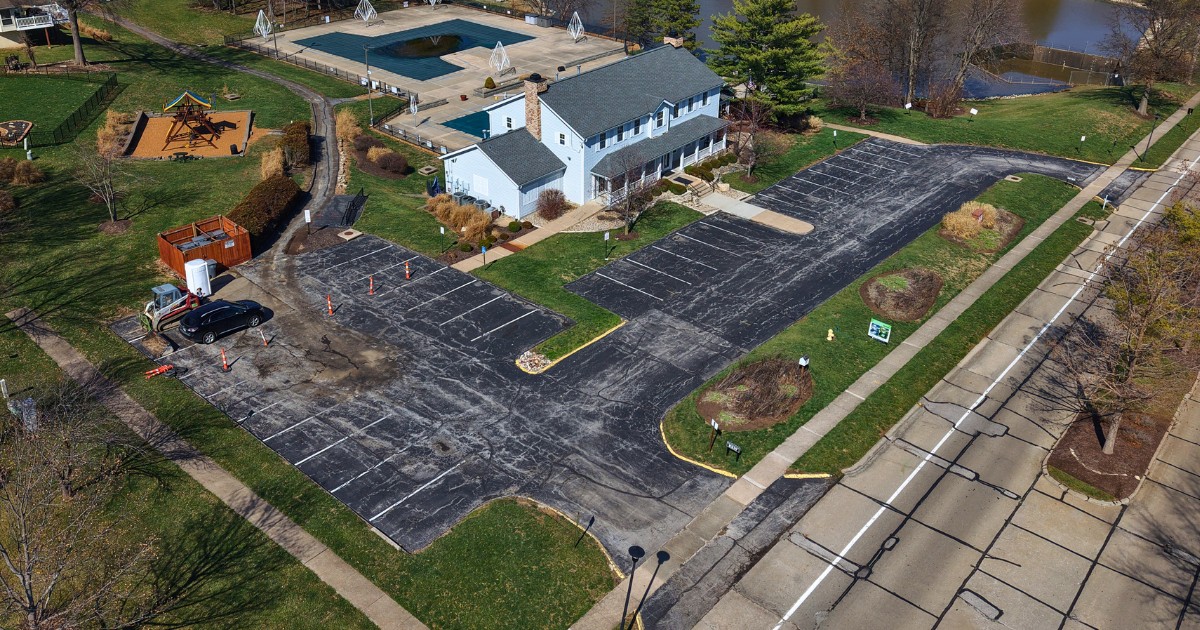
Before and after images of a parking lot repaired by Byrne & Jones

Step 4: Striping, accessibility and liability

Striping is where pavement maintenance turns into a legal question rather than a facilities one.

Faded stall lines, worn arrows and illegible fire lanes create real exposure, as do accessible stalls and access aisles that have faded past the point of being identifiable or that no longer meet current dimension and slope requirements. Restriping costs very little compared with almost everything else here, so treat it as a recurring item rather than an occasional refresh.

Two practical notes. Restripe after sealcoating, never before. And where the layout allows it, shift stall lines slightly between restripings so traffic does not wear the same channels into the surface year after year.

The same reasoning extends past the asphalt. Curbs, wheel stops, sidewalk transitions and pedestrian routes sit in the same drainage system and the same premises liability picture, so include them in both the inspection and the budget.

Step 5: Build a budget ownership will approve

Pavement is easier to fund when you stop presenting it as one unpredictable expense and split it in two.

The annual operating line covers recurring, predictable work: inspections, sweeping, crack sealing, minor patching, restriping, and sealcoating spread across its cycle. Fund it every year whether or not anything looks urgent, because deferring it is what creates the large numbers later.

The capital reserve covers the eventual overlay or rebuild. Your condition assessments give you an approximate remaining life for the surface, so you can work backward from an estimated replacement cost and divide it across the years you have left. A lot with roughly eight years of surface life and a known replacement figure has a reserve number you can defend in a budget meeting.

Presented this way, the operating line reads as the thing pushing the capital number further out rather than as another request competing for the same money. For figures on what individual work items run, see our parking lot cost guide.

Step 6: Keep the property open while work happens

For most commercial sites this is the real constraint. A lot closed for a week is a business problem no matter how good the pavement looks afterward.

Nearly all parking lot work can be phased. A workable approach looks like this:

  • Divide the lot into zones and sequence them so a set percentage of stalls stays open throughout.
  • Map the required routes first: fire lanes, accessible stalls and the paths from them to the entrance, loading docks, drive-through lanes and emergency egress. These constrain the sequence more than stall count does.
  • Work off-peak. Retail sites usually phase overnight or midweek, office parks on weekends, schools and campuses over the summer, and healthcare or industrial sites overnight with tight reopening windows.
  • Confirm cure and reopening times before you publish a schedule. Sealcoat and striping both need cure time that varies with temperature and humidity.
  • Tell tenants early and give them a zone diagram with dates and alternate parking. Disruption people were warned about generates far fewer calls.
  • Build in weather contingency. Asphalt and sealcoat have temperature minimums, so assume you will lose days and publish the backup plan alongside the schedule.

It is reasonable to ask any contractor for a phasing plan before you sign anything.

Step 7: Choose a contractor before you need one

Set the relationship up while the lot is still in decent shape. You will get straighter assessments than you would calling around after a pothole has become a claim.

Look for a contractor running their own crews and equipment rather than layering subcontractors, with control over the asphalt mix and the ability to investigate base and subsurface conditions instead of quoting the surface alone. It also helps if they are willing to tell you a repair is not needed yet. Ask for references on properties similar to yours, since a company that does highway work well does not necessarily phase a shopping center well. Our guide to selecting an asphalt paving contractor goes further on comparing bids.

If you are past maintenance and comparing surfaces for a rebuild, start with asphalt vs. concrete for parking lots.

Parking lot maintenance checklist

Monthly

  • Sweep and clear debris, especially around drains and catch basins
  • Clean oil and chemical spills as they happen
  • Note any new potholes or surface breaks

Twice a year, spring and fall

  • Full walking inspection with photos from fixed reference points
  • Check for standing water 24 hours after rain
  • Inspect curbs, wheel stops and sidewalk transitions
  • Confirm accessible stalls, access aisles and fire lanes are legible

Every one to three years

  • Crack seal any new cracking
  • Patch failed areas before they spread
  • Restripe as legibility declines
  • Sealcoat on cycle, once the surface has faded and cracking has been addressed

Every 8 to 15 years, depending on traffic and condition

  • Overlay or resurface once patching exceeds roughly 30% of the lot
  • Reconstruct or reclaim when the base has failed or drainage must be regraded

Annually, on paper

  • Update the condition assessment
  • Fund the operating line
  • Adjust the capital reserve against remaining surface life

Timing these to your climate matters as well. If you are in a freeze-thaw region, our season by season parking lot maintenance calendar lays out which month each task belongs in.

Get an assessment in your market

Byrne & Jones has built and maintained commercial pavement for more than 50 years, with our own crews, our own equipment and our own material plants across the Midwest and Mid-South. For a condition assessment and a maintenance plan on your property, start with the office nearest you.

Or contact us and we will point you to the right team.

5 Things to Consider When Selecting An Asphalt Paving Contractor

5 Things to Consider When Selecting An Asphalt Paving Contractor

5 Things you Should Think About Before Selecting an Asphalt Paving Contractor

NewAsphaltConstruction

Most commercial property owners prefer asphalt paving, over concrete, due to its quick construction, price, strength, and simplicity to maintain. It is no wonder asphalt is considered the most appealing and cost-effective choice of pavement surfaces today.

But remember that there are plenty of factors that can affect the outcome of an asphalt paving project. When choosing the right asphalt paving contractor, opting for the lowest bid is not always the best move.

You must consider the following factors so you can make a well-informed decision.

1. Years of Experience and References

When selecting a commercial asphalt paving contractor, it is important to know how long they have been in business, and what type of projects they typically build or maintain. It is good to know what services they self-perform and what ones they sub out to other contractors. Those who can communicate in an informed way while delivering great examples of challenging projects are most likely the best partners for your asphalt paving project. In addition, it’s a good idea to get a list of their references, or a project list so you can better understand the type of jobs they typically do.

AsphaltBlogFI 1 1

2. Material selection and thickness

Not all asphalt is created equal. Since most are recycled over and over again, asphalt has different grades, each with different percentages of the recycled material they contain. Low-quality asphalt can greatly affect the longevity and look of your pavement.

Make sure that the contractor you choose only makes use of high-grade asphalt as this contains less recycled materials. This will increase the life of the pavement while reducing maintenance cost.

Ask, where the company is getting their material and what type of material they are using on your project and why?

If your parking lot has truck traffic, it’s important the material thickness is appropriate for the vehicle weight. Make certain the proposal states how thick the asphalt material will be after compaction.

3. Equipment and number of paving crews

Scheduling of your project can be delayed by weather, number of crews, and quality of equipment the contractor has.

Check if the asphalt paving company has a sizable team. Generally, an efficient asphalt paving crew will have five to eight workers. Being understaffed can delay and affect the outcome of the project. The more paving crews one has, the better it is for you. They can schedule multiple projects and get to them faster.

The newer the equipment, the better the finished product – and less delays due to mechanical issues. An efficient asphalt paving contractor makes use of the most advanced paving machines to ensure a long-lasting, great-looking asphalt pavement.

Over time equipment will break down. Does the company have enough paving machines, rollers and trucks to account for this?

AsphaltBlogFI

4. Scope of work

Some scope of work documents can be unclear. If you are getting bids from different paving contractors, a clear scope of work document will make it a lot easier for you to compare the bids of each service provider.

Choose a detailed, accurate scope of work that meets your needs as this lays the foundation for an effective, durable paving project.

Things to look for:

  • Total square yards or square feet
  • Total thickness of the asphalt after it is fully compacted
  • Is the area of construction or maintenance well defined?
  • Are the repair methods the same? Are they patching, or are they milling?Understand the scope and items they are proposing. – an inexpensive repair could mean fixing it twice.
  • Payment terms
  • Items that are excluded
  • How long will it take to complete? Number of days.

5. Insurance Coverage

Make certain you request to see that the company has insurance. They should give you their Certificate of insurance along with their bid or before they start the job. Always ask for it.

Warranty

A reputable contractor will stand by their work. Moreover, they make customer satisfaction their priority. A project warranty will ensure that the work is done to industry standards.

Warranties may vary depending on the project circumstances, so make sure to have all information in writing before the project starts. Asphalt installation experts may also provide tips to extend the life of your newly paved surface – follow their recommendations and your asphalt should last for several years.

St. Louis Asphalt & Concrete Contractor Expands To Ohio

St. Louis Asphalt & Concrete Contractor Expands To Ohio

St. Louis Asphalt & Concrete Contractor Expands To Ohio

BenTraetow

Ben Traetow Helps Expan Byrne & Jones Construction into Ohio

“Ben Traetow, a Delaware native, has been named market leader for the new office. He worked for the company in St. Louis for seven years after graduating from Ohio State University, before coming back here a year ago for another job. But the company reached out to him and brought him back into the fold.

“Columbus is a very (economical) market so it’s good from that standpoint,” Traetow said. “Compared to when we moved away in 2011, it’s wild. I think it’s a very forward thinking city, an eclectic city, and I think that makes it attractive to a lot of people.” –  (https://www.bizjournals.com/)